If you are weighing a Bal Harbour oceanfront condo, the biggest question usually is not whether to buy here. It is whether you should choose an established resale residence or wait for a new development opportunity. In a village with very limited oceanfront supply, that choice can shape your pricing, timing, carrying costs, and day-to-day ownership experience.
Bal Harbour is a rare market where scarcity matters as much as square footage. The village is essentially built out, with about 245.3 acres developed and only about 4.32 acres remaining vacant. That means most future inventory will come from redevelopment, not open land, which helps explain why both standout resale condos and new projects can command serious attention. Let’s dive in.
Why Bal Harbour Supply Is So Limited
Bal Harbour is a one-square-mile village on the northern tip of Miami Beach, positioned roughly between Miami and Fort Lauderdale. Its Ocean Front District is intended for high-rise luxury residential and resort-type uses east of Collins Avenue, which reinforces a tightly controlled, high-end coastal market.
For you as a buyer or seller, the key takeaway is simple: supply is structurally limited. Because the village is already largely developed, oceanfront opportunities tend to be selective, and truly new product is rare.
The village is also in the middle of broader public improvements, including a utility modernization program expected to continue through 2027 and the Harbourfront Park, Jetty, and Cutwalk project expected to complete in 2027. These upgrades support the long-term quality of the area, but they also mean nearby construction and capital work may be part of the ownership backdrop in the near term.
What Resale Means in Bal Harbour
In many markets, “resale” can sound like a compromise. In Bal Harbour, that is not the right lens. Established buildings here range from more compact oceanfront residences to large branded luxury condominiums with extensive services.
Harbour House is a good example of the breadth within the resale category. Built in 2007, it has 457 units with floor plans ranging from about 500 to 2,000 square feet, along with concierge, security, valet, a pool deck, spa, fitness center, tennis courts, business facilities, and a private theatre. Published listings on its building page range from about $529,000 to $2.55 million, showing how broad the entry points can be within one address.
At a different tier, One Bal Harbour reflects the upper end of established oceanfront inventory. It is a 26-story condominium with 185 units and residences from about 1,918 to 3,282 square feet, with attached Ritz-Carlton hotel services including spa access, concierge, valet, and dining. Current published listings range from about $2.195 million to $6.98 million.
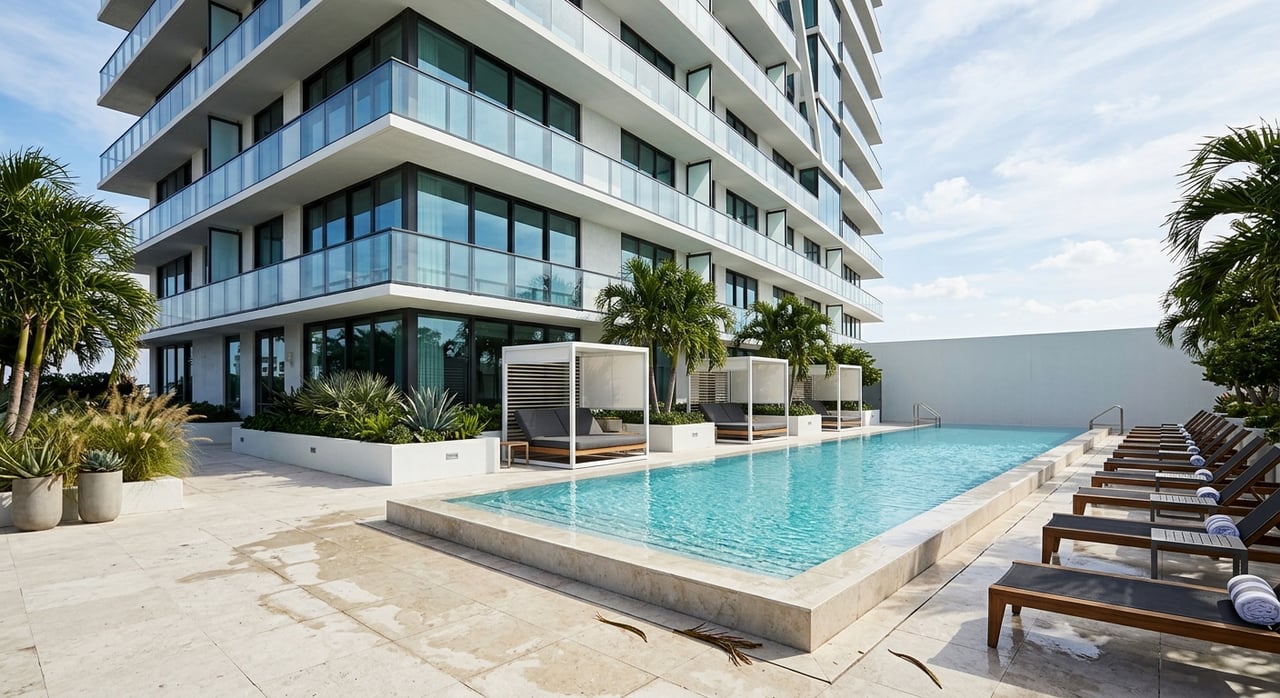
The St. Regis Bal Harbour also remains an important benchmark when comparing resale choices. Opened in 2012, it includes three 27-story glass towers with a 14,000-square-foot spa, two ocean-view pools, private beach access, and butler service. Even though it is an established address, it shows how a strong brand and service package can keep a property highly competitive over time.
What New Development Looks Like Today
When buyers think about “new” in Bal Harbour, the current flagship example is Rivage Bal Harbour. The project is planned for 10245 Collins Avenue and is positioned as a low-density, highly serviced oceanfront offering with residences ranging from about 3,300 to 12,600 square feet and pricing from $8 million.
Its published amenity package is extensive, with about 25,000 square feet of amenities, a resident dining room, social lounges, spa, fitness pavilion, pool decks, beach club access, pickleball and padel courts, plus butler and estate-manager services. The project has also been described with slightly different unit counts and tower heights in public materials, which suggests the design has evolved during pre-construction.
The broader point matters more than the exact count. Rivage is being marketed less like a traditional condo tower and more like a vertical private estate experience, with lower density, larger homes, and a heavier service model than much of the established stock.
Newer Resale Can Blur the Line
Not every choice is strictly “older resale” versus “brand-new development.” Oceana Bal Harbour is a useful middle ground. Completed in January 2017, the 28-floor building has 240 beachfront units and emphasizes floor-through residences, unobstructed ocean and bay views, and deep balconies.
For many buyers, this kind of property can offer a newer design language without the uncertainty of pre-construction. It can also provide a clearer real-world ownership picture because the building is already operating and its maintenance fee is publicly listed at $1.35 per square foot.
Resale Versus New Development: The Real Trade-Offs
The best choice in Bal Harbour usually comes down to priorities, not labels. Resale and new development each solve a different problem for the buyer.
Why some buyers prefer resale
Resale often appeals to buyers who want a residence they can evaluate today. You can assess the building’s atmosphere, services, finishes, views, and operations in real time rather than relying on plans and marketing materials.
Resale can also offer a wider pricing band. Based on the examples above, the spread runs from entry points under $1 million in some established product to multi-million-dollar branded residences in the top tier.
Immediate or near-immediate occupancy is another advantage. If your timeline matters, a completed building can remove much of the waiting and execution risk tied to pre-construction delivery.
Why some buyers prefer new development
New development appeals to buyers who want untouched finishes, the newest systems, and a more current amenity stack. In Bal Harbour, that can also mean a lower-density experience with larger residences and a more private service model.
You may also value the design freshness that comes with a ground-up project. In the ultra-luxury segment, that often includes larger floor plates, stronger privacy features, and programming that feels closer to a private club than a standard condominium.
For some buyers, that distinction is worth paying for. Especially at the top of the market, age alone does not drive value as much as service architecture, privacy, scale, and positioning.
Comparing Costs Beyond the Purchase Price
Price per residence is only part of the equation. Your monthly carrying costs can differ meaningfully between newer and more established buildings.
Oceana’s published maintenance fee is $1.35 per square foot, while Rivage’s published estimated maintenance fee is $2.10 per square foot. That gap suggests that more service-intensive, newly built product may carry materially higher monthly costs even before taxes and insurance are factored in.
With established buildings, a lower monthly fee does not automatically mean lower ownership risk. Your due diligence should focus on building-specific maintenance history, reserve strength, and capital planning, especially in a market where public infrastructure work and long-term upkeep remain relevant.
What the Market Data Says
Bal Harbour remains a high-end condo market, but there is still a meaningful range between the median sale and the trophy tier. According to Miami Realtors Q1 2026 local residential metrics, Bal Harbour condo and townhome sales posted a median sale price of $1.607 million and an average sale price of $2.664 million, with 32 closed sales, 133 active listings, and 15.2 months of inventory.
In May 2026, Realtor.com reported a median listing price of $3.2 million, 153 active listings, a median 108 days on market, and a 93% sale-to-list ratio for the broader Bal Harbour housing market. That points to a market with significant inventory depth at the high end, but also one where pricing discipline still matters.
At the very top, Miami Realtors set Bal Harbour’s condominium luxury threshold at $10.4 million and its ultra-luxury threshold at $12.3 million for Q1 2026. The same report showed 27 million-dollar condo sales and an 82% million-dollar market share, underscoring just how concentrated this market is in the luxury segment.
How to Decide Which Path Fits You
If you are choosing between resale and new development, start with your decision framework rather than a favorite building. In Bal Harbour, the strongest purchase is usually the one that matches your timeline, lifestyle priorities, and tolerance for uncertainty.
A resale condo may fit you best if you want:
- Immediate or faster occupancy
- A proven building with visible operations
- A wider pricing range
- The ability to compare actual views, finishes, and service levels today
A new development may fit you best if you want:
- Brand-new systems and untouched interiors
- A more current amenity and service package
- Larger-scale residences in a low-density setting
- A product designed around privacy and estate-style living
There is no universal winner. In Bal Harbour, scarcity, view corridors, service quality, and brand strength often matter more than whether a building is technically newer.
Why Guidance Matters in This Market
Bal Harbour is not a high-volume, interchangeable condo market. Each oceanfront building can represent a very different ownership experience, from compact luxury product to estate-scale residences with hotel-style services.
That is why a careful comparison matters. You want to evaluate not just asking price, but also monthly costs, building positioning, service package, occupancy timing, and how each option fits your long-term goals.
If you are considering a resale condo or evaluating new development in Bal Harbour, working with a discreet advisor who understands luxury pricing, negotiation, and product positioning can help you make a clearer decision. For a private consultation and tailored guidance, connect with Isaac Malagon - Sotheby's.
FAQs
What is the main difference between resale and new development condos in Bal Harbour?
- Resale usually offers immediate occupancy, a proven building, and a wider price range, while new development typically offers brand-new finishes, newer systems, and a more extensive amenity and service package.
Are there many new oceanfront condo projects in Bal Harbour?
- No. Bal Harbour is essentially built out, with only about 4.32 acres remaining vacant, so most new supply comes from rare redevelopment opportunities rather than open land.
Is resale inventory in Bal Harbour only older product?
- No. Bal Harbour resale inventory includes both long-established buildings and newer completed projects such as Oceana Bal Harbour, which was completed in 2017.
Are monthly condo fees higher in new Bal Harbour developments?
- Published figures suggest they can be. For example, Oceana lists a maintenance fee of $1.35 per square foot, while Rivage lists an estimated $2.10 per square foot.
Is Bal Harbour mainly a luxury condo market?
- Yes. Miami Realtors reported an 82% million-dollar market share for Bal Harbour condominiums in Q1 2026, which shows how concentrated the village is at the high end.
What should you compare when choosing a Bal Harbour oceanfront condo?
- Focus on pricing, monthly carrying costs, building services, view quality, occupancy timing, and the overall ownership experience each property offers.