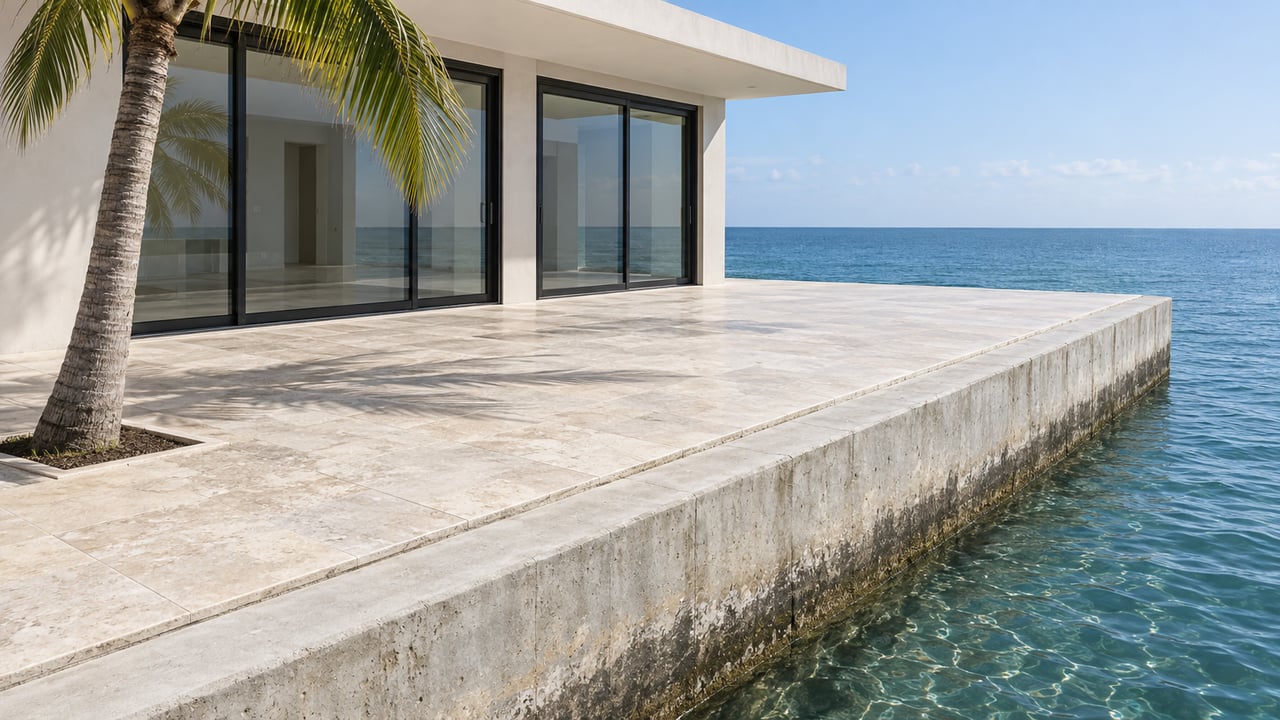
A buyer under contract on a canal-front home in Fort Lauderdale gets a marine contractor's report back during the inspection period. The seawall needs work: some cracking along the cap, a section where the fill behind the wall has settled. The homeowner's own records show a repair years ago that covered maybe a third of the shoreline. The new work covers a bit more. Nobody flags a problem until someone runs the math and the repair crosses 50 percent of the total shoreline length.
At that point, under Broward County's resiliency code, the project stops being a repair. It becomes a replacement, in full, to current elevation standards, with the permitting timeline and cost structure of new construction rather than maintenance. The buyer's contractor didn't misread anything. The threshold did exactly what it was designed to do.
This is the mechanism that waterfront buyers in Fort Lauderdale need to understand before they write an offer, not after the inspection period exposes it. It shapes what a seawall repair actually costs and why two homes on the same canal with identical square footage can carry very different closing math.
The Rule in the Permit Application
Broward's resiliency code defines a substantial repair in plain terms: work along more than 50 percent of a property's shoreline length, or appurtenant work exceeding 50 percent of the cost of the flood barrier, triggers a full replacement requirement rather than a standard repair permit. Once that line is crossed, the wall has to meet the current elevation standard, not the standard it was built to decades ago.
The current elevation standard itself has moved over the past several years, and the sources describing it don't fully agree on the schedule. Some materials describe a phased target. A 2023 Waterfront Times account of a Fort Lauderdale ordinance describes an immediate increase from 3.9 feet to five feet. More recent guidance for waterfront communities like Sunrise Key also discusses changing elevation standards. Given how much this has shifted, treat any online summary, including this one, as a starting point rather than the final word, and confirm the current threshold directly with Fort Lauderdale's Building and Marine permit offices before you budget a project or write an offer.
What stays consistent across every source is the mechanism itself: cross the 50 percent line, and you're building to today's standard, not yesterday's.
What the Threshold Actually Costs
The dollar difference between staying under the line and crossing it is not small.
| Scope of work | Typical cost | What triggers it |
|---|---|---|
| Height increase on an existing, structurally sound wall | $500 to $1,000 per linear foot | Compliance upgrade without full replacement |
| Full replacement, 75-foot lot | $30,000 to $80,000 or more | Repair scope exceeds 50 percent of shoreline length or cost |
| Permit review across engineering, environmental, and local approvals | Three to four months | Any waterfront structure permit in Broward County |
A 75-foot lot sits close to a size where a homeowner doing incremental repairs over the years, a section here, a cap fix there, can find themselves within striking distance of the threshold without ever deciding to cross it on purpose. Without records showing the scope of each project, the cumulative work can be hard to assess.
For a buyer, that means a seawall's repair history tells you less than it looks like it tells you. A clean-looking log of "minor repairs" over a decade can describe a wall that's been managed right up to the edge of the threshold the entire time. This is why a marine contractor's independent structural assessment, not just a visual walk-through and the seller's paperwork, belongs in every waterfront inspection period. Ask what percentage of the total shoreline length each prior repair covered. If nobody can answer that question with a number, treat the wall as untested.
The Bridge Number That Ends Negotiations Fast
Seawalls aren't the only number that catches buyers off guard. Fixed bridge clearance is the other one, and it's arguably worse because there's no repair that fixes it.
Older infrastructure on Fort Lauderdale's canal network commonly clears around 15 feet at mean high water. For a buyer purchasing specifically for boat access, that number determines whether their vessel, or the vessel they're planning to buy next, can physically reach the home at all. It is not listed on the MLS sheet. It has to be verified with the city, against the specific route from a specific dock to open water, before the vessel and the house get treated as a package deal.
Depth matters just as much as height. Buyers looking to berth larger vessels want reliable depth of eight to 12 feet at mean low water, confirmed by recent soundings from a marine surveyor rather than an old survey attached to the listing. Two homes with identical linear footage on the same canal can have meaningfully different depth profiles, and depth is what determines what can tie up there at every tide, not just the tide the listing photos were taken on.
Price Per Linear Foot, Not Square Footage
Once the marine mechanics are understood, the pricing logic follows. Waterfront value in Fort Lauderdale is built from price per linear foot of frontage on a specific waterbody, adjusted for depth, bridge clearance, exposure, and the condition of the dock and seawall, with interior finishes treated as a secondary adjustment rather than the starting point.
That's a different valuation model than most buyers arrive with, and it explains price bands that otherwise look inconsistent. Rio Vista, one of the city's oldest established neighborhoods, sits along the New River and its tributaries with wide, deep-water canals and quick access to the Intracoastal and the Atlantic. Its architectural mix runs from 1950s ranches to contemporary new construction, which produces entry points as low as $1.5 million for a renovation project and up to $6 million or more for a finished custom home on a wide lot, with walkability to Las Olas Boulevard as a consistent draw. Homes on the Intracoastal in Coral Ridge and Harbor Beach typically list from $2 million to $10 million, with the range driven far more by lot width and dock configuration than by house size. Harbor Beach in particular occupies a private, gated peninsula with direct Intracoastal access, which is part of why it's treated as one of the city's most sought waterfront addresses.
Freshwater canal properties, less common but present in the market, sell for less than saltwater canal frontage, but they carry lower flood insurance and no salt corrosion on docks or seawalls. For a buyer who wants a water view without the full marine lifestyle price tag, that trade-off is worth pricing out explicitly rather than defaulting to saltwater because it sounds more prestigious.
The Permit Timeline That Should Shape Your Closing Date
Any waterfront structure permit in Broward County, dock, seawall, or boat lift, typically runs three to four months once engineering review, environmental approval, and local sign-off move through their sequence. If a buyer's plan includes replacing a dock or raising a seawall shortly after closing, that timeline belongs in the transaction schedule from the start, not discovered afterward.
There's a seasonal wrinkle too. Benthic resource surveys check for seagrass and other protected marine life, and Breezy Permits identifies April 1 to September 30 as the official growing season for those surveys. A buyer closing in November who wants dock work done by spring needs to plan around that window, not against it.
Unpermitted work is its own closing-day surprise. Confirming permit history for the dock, lift, and seawall is a five-minute records check that prevents a much longer conversation after closing.
Timing a purchase around Fort Lauderdale's boating calendar matters on the demand side as well. The Fort Lauderdale International Boat Show and the winter refit season that follows it bring more boaters, brokers, and crew into the market, which tends to increase both slip pressure and buyer activity in the months around it.
FAQ
Does every waterfront home in Fort Lauderdale need a marine survey, not just a home inspection? Yes, for any purchase where the dock, seawall, or boat access is part of the value proposition. A standard home inspector isn't scoped to assess seawall structural condition, dock pilings below the waterline, or depth at mean low water. That's a separate marine surveyor or structural engineer, engaged independently.
What documents should a seller have ready to support a waterfront asking price? A survey with recorded linear waterfront footage, a recent hydrographic sounding, bridge clearance notes, seawall records including age and permit history, and dock specifications with permits on file. Buyers increasingly expect this documentation up front rather than requesting it during the inspection period.
Is a freshwater canal home actually a good alternative to saltwater frontage? It depends on what the buyer values. Freshwater frontage costs less to insure and doesn't expose docks and seawalls to salt corrosion, but it typically doesn't offer direct ocean access. For a buyer who wants the water view and lifestyle without full yacht access, it's worth serious consideration rather than an automatic pass.
Waterfront due diligence in Fort Lauderdale rewards the same discipline as any high-stakes negotiation: know the number before the other side has to tell you what it means. If you're evaluating a specific canal-front property and want the marine and permit history read correctly before you're locked into a contract, Isaac Malagon can walk through it with you.
This article is general information, not legal, tax or financial advice. Consult a qualified professional about your situation.